.svg)
.svg)
The Rise of 'Agent Saturation' in QA Operating Models

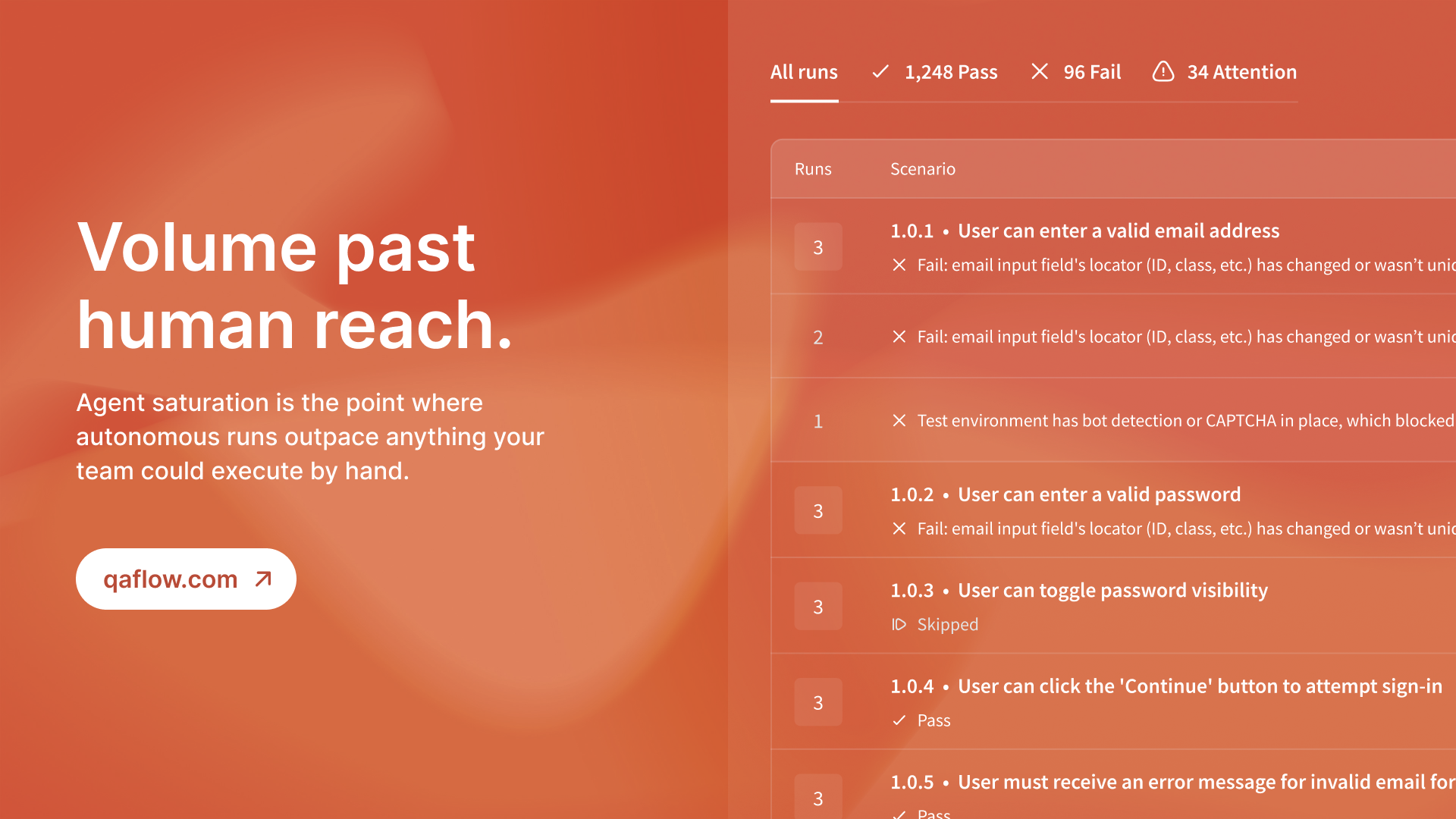
Thirty percent of his engineering budget. That's what a CTO told me he was spending just to keep broken Playwright scripts alive. He hadn't scaled quality — he'd scaled technical debt. For most Series B-C startups, there's a wall: hire more QA engineers and the release cycle actually slows down. The cost of managing brittle automation eats the speed that new features are supposed to bring. An AI QA engineer isn't a nice addition; it's the only way to stop the bleed.
Why traditional automation is a velocity tax
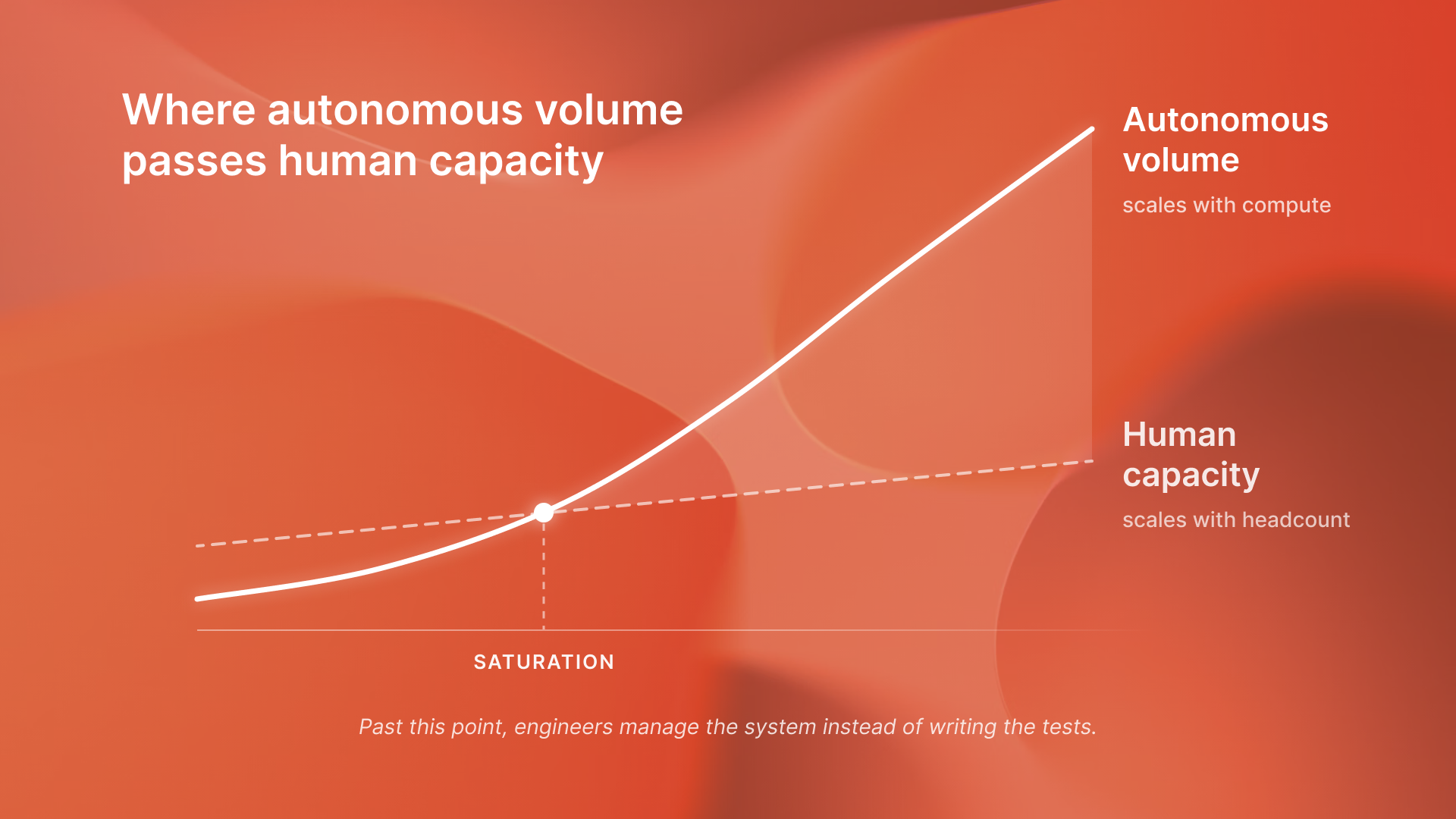
A script that follows a specific path looks reliable — until a developer changes a CSS selector or moves a button. Then the test breaks. Senior engineers end up spending more time fixing old tests than building new features. When linear manual QA scaling becomes cost-prohibitive, teams have to decouple testing volume from headcount to keep delivery speed.
Testing model comparison
Compare the two approaches. Automated testing is rigid and implementation-based: every UI change demands a manual script update. Autonomous testing works differently. It's intent-based and self-healing. It uses AI to understand the user goal rather than the specific UI structure. The maintenance tax tells the story. Automated testing requires 1 human hour of maintenance for every 5 hours of development. Autonomous testing reduces that to near zero.
Hiring an AI QA engineer to eliminate technical debt
Stop paying the maintenance tax and your team stops playing defense. Startups that reach this point stop chasing the dev team and start aligning QA with growth. Moving beyond simple script generation means eliminating human decision points across the entire workflow.
Defining agent saturation in the QA stack
QA agent saturation is the moment autonomous testing volume surpasses what humans can do manually. QA hits this state first because its outputs are structured and binary. Repeatable verification means AI agents don't need constant human help. That's how you solve the QA bottleneck that traditional hiring can't touch.
Binary outputs and structured logic
QA is about pass or fail. That's it. That binary structure is exactly what AI agents thrive on. Using intent-based testing, teams can verify thousands of permutations no human could cover in a single sprint.
The harness effect on token efficiency
I call it the Harness Effect. The way you wrap your agents sets both token cost and feedback speed. A bad harness gives you high latency and wasted spend. To avoid that, you need an Agent-as-a-Service architecture that lets software execute multi-step reasoning independently, not just wrap a single prompt.
The multi-agent advantage
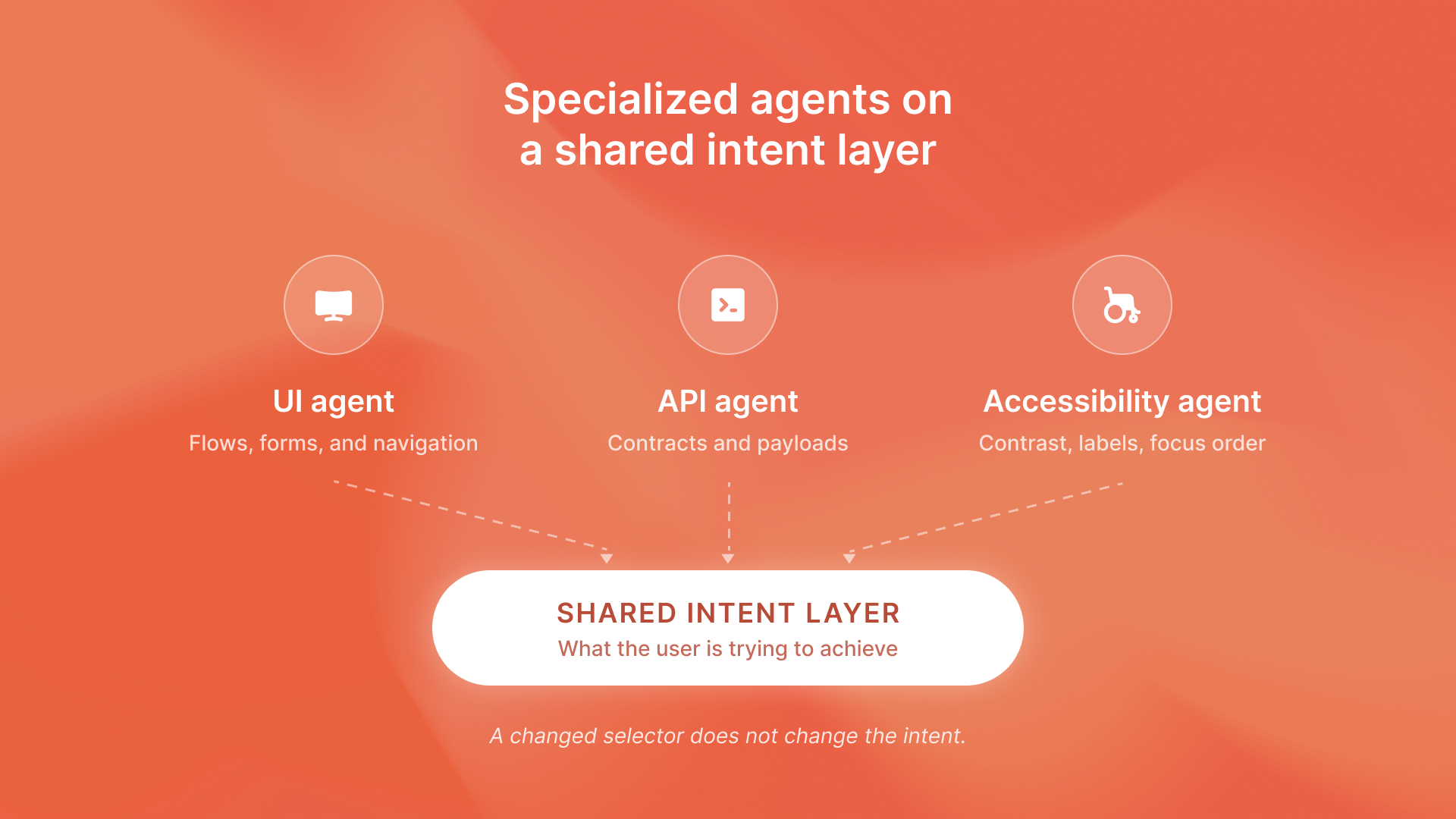
Single-agent models choke on complex multi-step user journeys. They lack the context to handle edge cases. Multi-agent systems fix that by distributing the cognitive load. But only if they're fed by a structured data pipeline that turns messy web content into reliable context. These systems work as collaborative architectures: specialized agents generate, execute, and audit test coverage based on intent, not DOM structure. That changes what humans do. Look at industries that have reskilled staff after routing routine service tasks to automation. Engineering teams need to shift from script writing to high-level orchestration.
How to hire AI QA expert talent for orchestration
To reach agent saturation, you need to change who you hire. No more executioners who write scripts. You want an AI QA engineer who orchestrates — one engineer managing hundreds of autonomous flows instead of one tester per feature. I looked at hiring patterns: teams that scale don't add headcount; they add impact. When hiring, look for people who understand system-level auditing over test execution. Modern teams also fold in API test automation AI for robust backend coverage. Start by redefining the role from test writer to system auditor. Then hire for strategic test orchestration skills, not script-writing proficiency. And implement tools that prioritize intent-based validation over implementation-specific checks.
The takeaway: auditing your QA operating model
Audit your operating model. First, calculate your maintenance tax: hours spent fixing scripts versus building new features. Then identify high-volume, binary test paths where agent saturation can start. Finally, move your QA leads into orchestrator roles focused on strategic QA expansion.
The bottom line
The numbers are clear: autonomous orchestration wins. You cannot scale a modern engineering org on 2015-era automation logic. Reach agent saturation or keep paying the velocity tax.
Schedule a demo with our team today to see how QA flow can improve your testing infrastructure and speed up your release cycles.

.png)
.png)
