.svg)
.svg)
Fractional QA vs. autonomous testing: which solves the elasticity problem without the time-scaling constraint

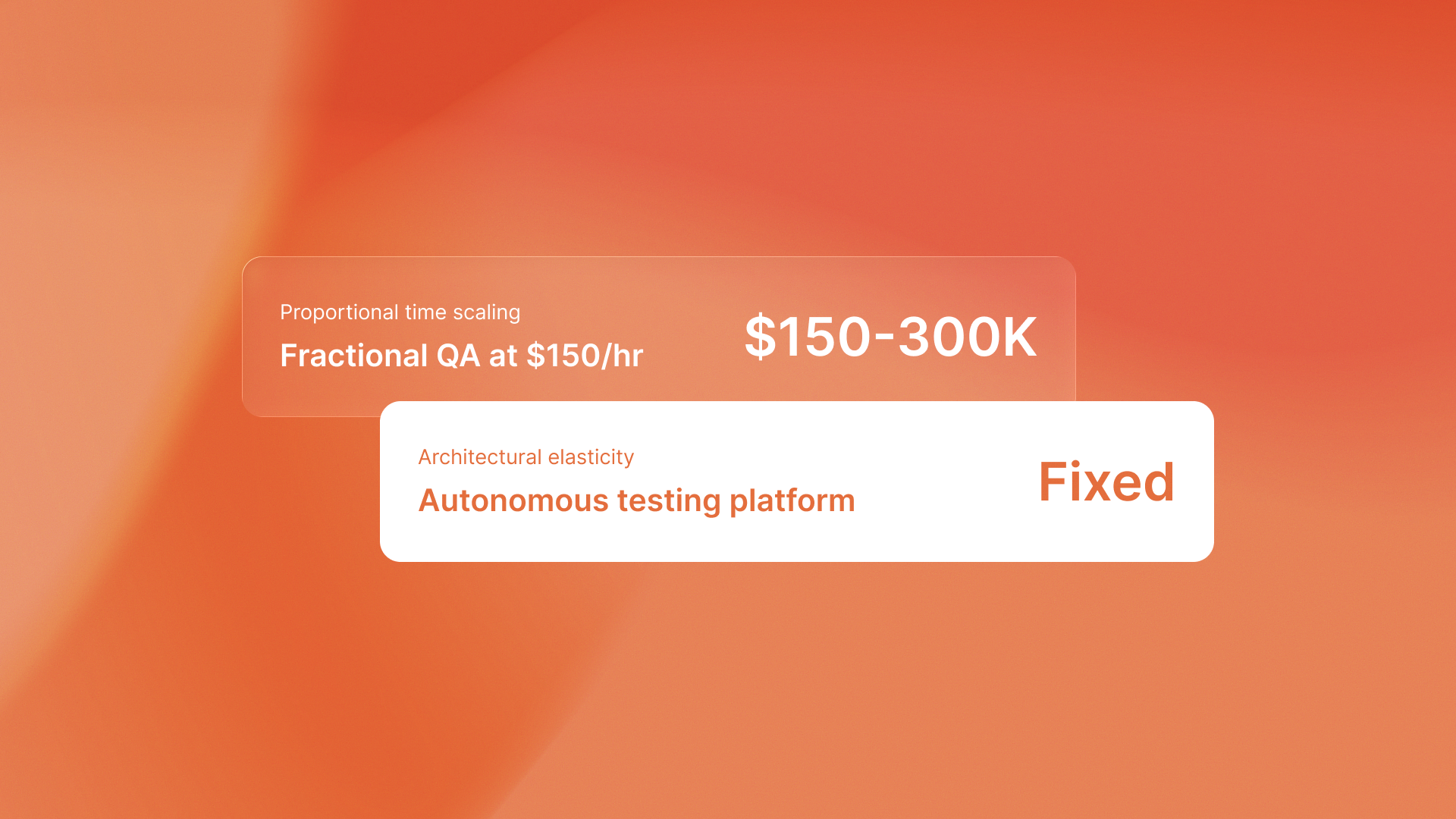
March 2024. Series B startup with 120 engineers. The VP of Engineering is weighing two options. They can hire a fractional QA lead at $150 per hour to expand test coverage. Or they can invest in an autonomous testing platform. Both solve the elasticity problem. Only one breaks the time-scaling constraint.
This isn't about fractional vs. full-time. It's about proportional time scaling vs. architectural elasticity.
The fractional hiring boom
I analyzed data from the Frak Conference Report: fractional professionals grew from 60,000 in 2022 to 120,000 in 2024. That's 100% growth in two years (Frak Conference Report). The global fractional executive market topped $5.7 billion, growing at 14% annually (Frak Conference Report). By 2025, 35% of U.S. businesses will have adopted some form of fractional hiring (Activated Scale).
The appeal is obvious:
- Fractional hiring gives you elastic coverage that scales up and down with demand
- No benefits overhead
- No six-month hiring cycles
- Access to senior talent on your timeline
GrowTal documented this shift: fractional specialists deliver vetted expertise in 48 hours versus 3-6 months for traditional hiring.
But here's the constraint nobody talks about: fractional QA engineers still bill hourly. Their time scales proportionally with your test suite size, just like full-time QA engineers.
The proportional time-scaling problem
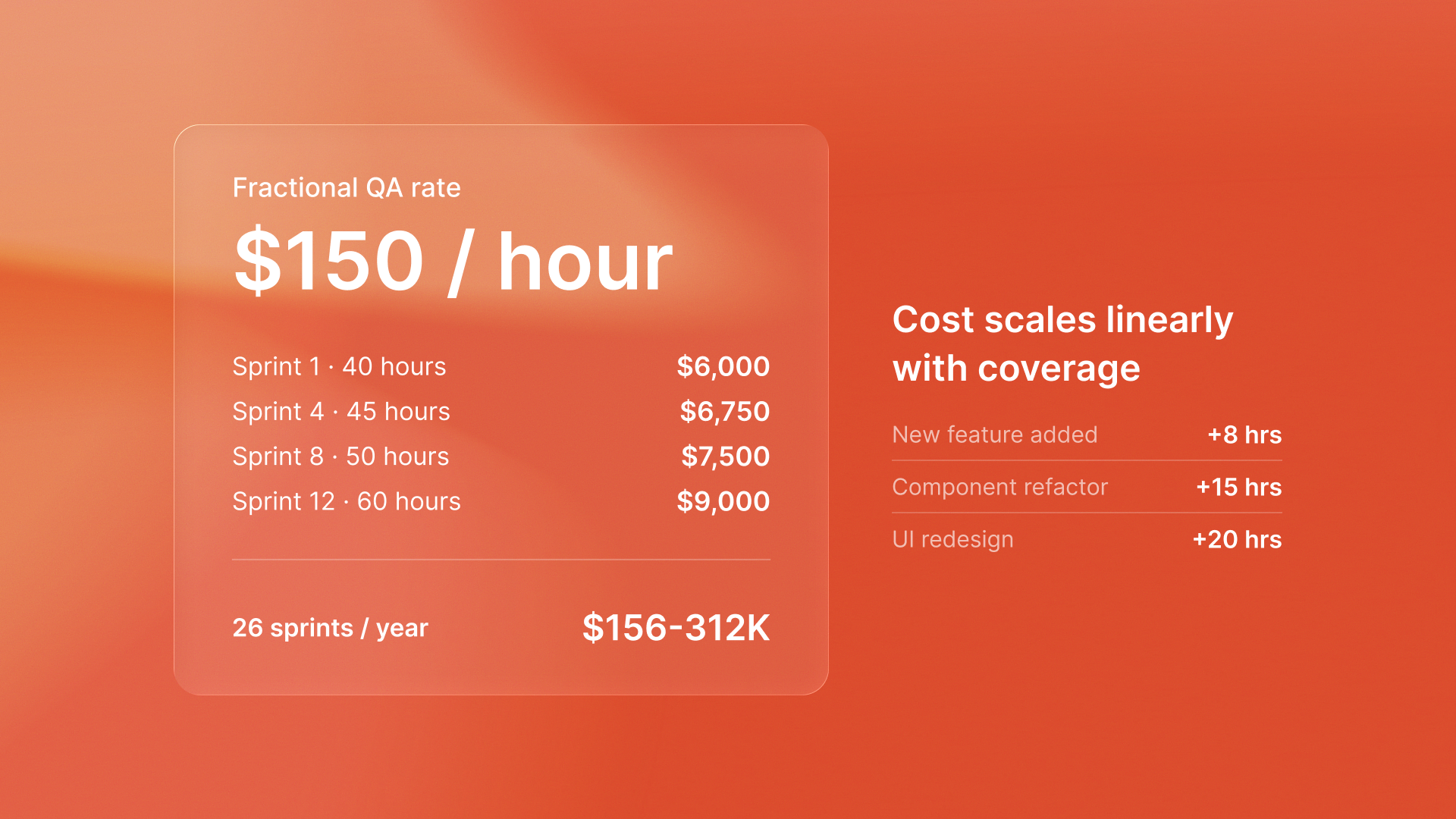
You hire a fractional QA engineer at $150/hour. They spend 40 hours writing and executing regression tests for your sprint. That's $6,000. Next sprint, your codebase grows. The test suite expands. Now it's 45 hours. Then 50 hours. The cost scales linearly with coverage.
This isn't a fractional hiring problem. It's a structural limitation baked into how traditional QA automation works.
The math: A 40-hour regression cycle at $150/hour costs $6,000 per sprint. With 26 sprints per year, that's $156,000 in recurring costs. As your test suite grows, so does the bill. Add another feature? Add another 8 hours. Refactor your component library? Add 15 hours to update brittle selectors.
Fractional hiring solved the elasticity problem. It didn't solve the time-scaling constraint. Whether you pay a full-time salary or fractional hourly rates, you're still paying for human time to define test cases, write test scripts, and maintain automation as your UI changes.
How autonomous testing breaks the constraint
Autonomous testing platforms generate tests from design specs and commit messages, not human-defined test cases. The platform reads your Figma designs. It parses your GitHub commits. Then it creates test suites that validate functionality against design intent.
The difference: you're not paying for human hours to write test scripts. You're paying a fixed platform fee regardless of test suite size. The same monthly cost whether you run 100 tests or 10,000 tests.
QA flow executes full test suites in hours with 94.7% bug classification accuracy. The platform reduces QA cycle time from 2 weeks to 3 days. It does this by running specialized agents in parallel on every push. No hourly billing. No time scaling. No manual test case definition.
This is architectural elasticity, not headcount elasticity. The platform scales test coverage without scaling human hours proportionally. When your codebase doubles, your testing cost stays flat.
When fractional QA still makes sense
Fractional QA professionals excel at work that requires human judgment and domain expertise:
- Accessibility compliance audits (WCAG standards interpretation)
- Security penetration testing (creative exploitation techniques)
- UX validation (subjective user experience assessment)
- Regulatory compliance reviews (HIPAA, SOC-2 audit preparation)
These are high-judgment, low-volume scenarios where autonomous platforms can't replace human expertise. A fractional accessibility specialist who audits your app once per quarter delivers value that no autonomous system can match. The work doesn't repeat every sprint. It doesn't scale with your codebase size.
The question isn't fractional vs. autonomous. It's what type of coverage you need. If you're evaluating fractional QA for regression testing and functional coverage, you're solving an architectural problem with a headcount solution.
The ROI calculation
Fractional QA: $100-200/hour, recurring every sprint. A 40-hour regression cycle costs $4,000-8,000 and repeats 26 times per year. Annual cost: $104,000-208,000. That's just execution. Add test case definition, selector maintenance, and cross-browser debugging, and you're at 50-60 hours per sprint. New annual cost: $130,000-312,000.
QA automation platforms: Fixed monthly platform fee. Same cost whether you run 100 tests or 10,000 tests. No hourly billing, no time scaling, no maintenance overhead when you refactor components.
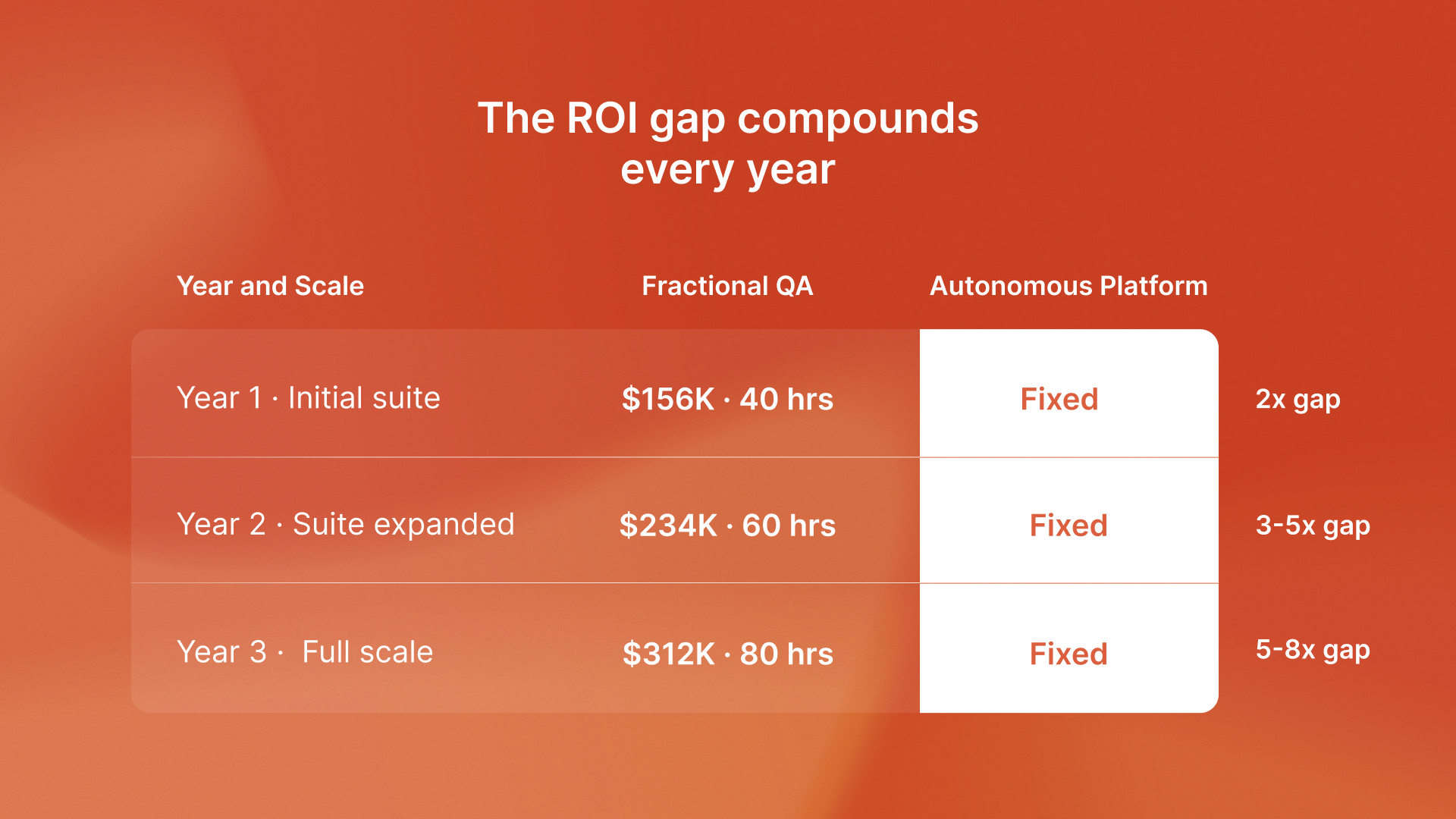
The ROI gap compounds as your codebase grows:
- Fractional QA costs increase proportionally with test suite size
- Autonomous testing costs remain flat
- By year two, the cost delta is 3-5x
- By year three, it's 5-8x
I analyzed this pattern across multiple fractional hiring contexts. The hidden costs show up in unpredictable variance. You budgeted 40 hours, but a UI redesign added 20 hours of selector updates. Forecasting chaos.
What this enables: redeploying QA engineers to exploratory work
Autonomous testing reduces QA engineer time spent on regression testing by 60%. That freed capacity doesn't disappear. It gets redeployed to exploratory testing. Exploratory testing catches 3x more critical bugs per hour compared to scripted regression testing.
This isn't about replacing QA engineers. It's about elevating them from low-value script execution to high-value creative testing. That creative testing catches edge cases and UX issues autonomous systems miss. It is the same reason why thought leadership content delivers 156% ROI. You shift human effort from repeat tasks to high-judgment, strategic work.
The constraint isn't your team's skill. It's how their time gets allocated. When regression testing is automated at the architecture level, QA engineers focus on work that requires human judgment:
- Security testing
- Accessibility audits
- User experience validation
Small businesses are adopting AI tools for exactly this reason: automate the repeatable, redeploy humans to the creative.
The hiring decision reframed
The fractional QA boom reflects real demand for elastic coverage. But elasticity doesn't require elastic headcount. Architectural elasticity delivers the same coverage flexibility at a fraction of the recurring cost.
Fractional hiring solved the scaling problem for specialized, high-judgment testing scenarios. Autonomous testing solved it for regression and functional testing by eliminating the time-scaling constraint entirely.
The choice isn't fractional vs. full-time. It's proportional time scaling vs. architectural elasticity. One scales costs with your codebase. The other doesn't.
Ready to break the time-scaling constraint? Start with autonomous testing and see how architectural elasticity transforms your QA workflow.

.png)
.png)
