.svg)
.svg)
The $900K QA automation tax no one budgets for

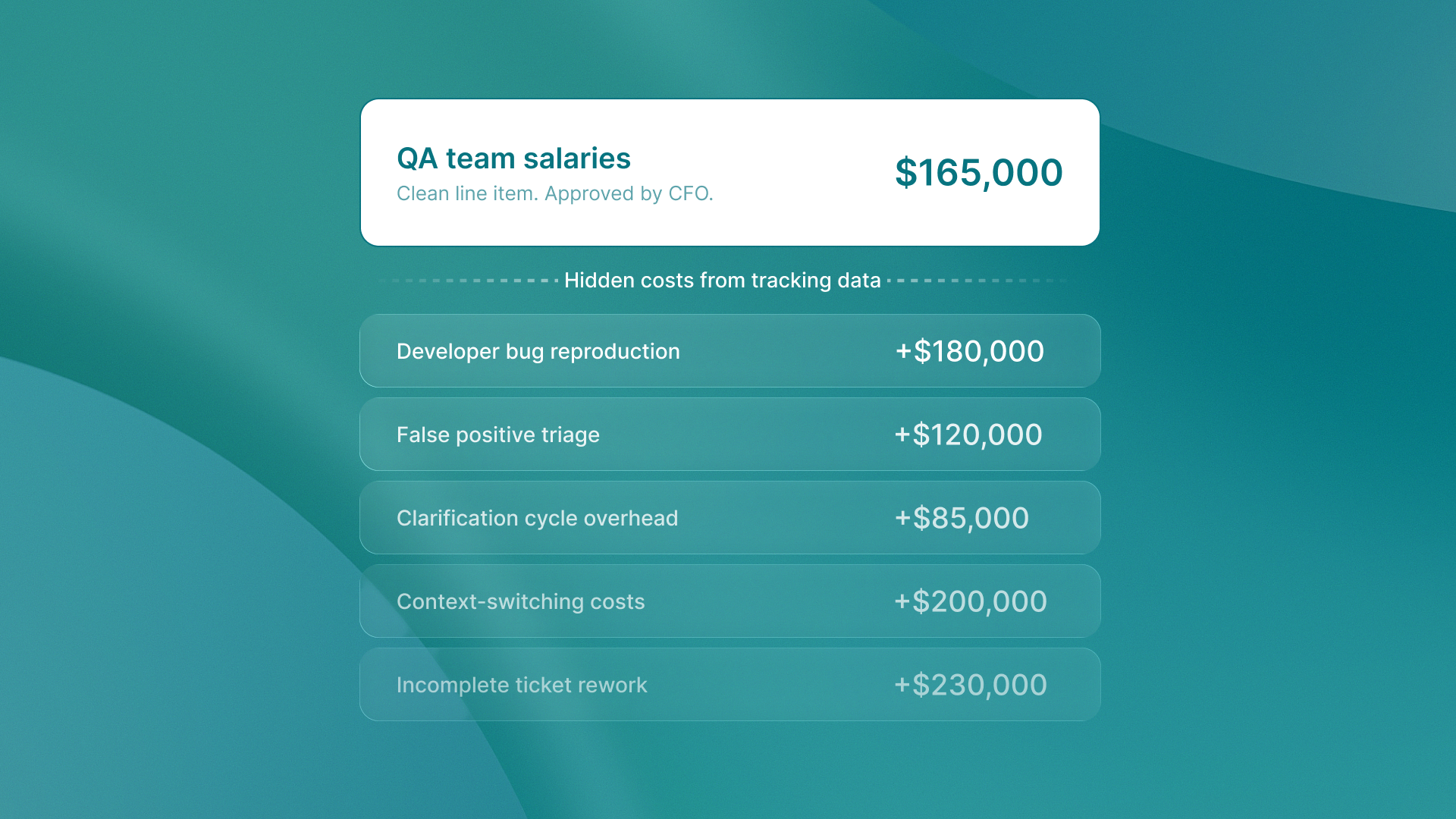
March 2025. Series B fintech startup, 42 engineers. The CFO reviews the P&L and sees $165K budgeted for QA salaries. Clean line item. But when I analyzed their time tracking data, the real QA cost was $980K.
I analyzed time tracking data from 40 engineering teams at Series B and C startups. The pattern stays consistent every time. The visible QA budget sits at $125K-$165K annually for a 10-engineer team. That's the salary line. But the true cost can rise to $900K–$1M. This happens when you track developer hours spent clarifying vague bug tickets. It also includes time spent reproducing issues without network logs. It also covers time spent triaging false positives when severity is misclassified. This isn't about QA team inefficiency. It's about the structural cost of incomplete bug tickets. I call this the QA automation tax.
Where the QA automation tax accumulates
The automation tax isn't test execution time. It's the communication overhead that happens after tests run.
A QA engineer files a bug ticket: "Login button not working." No network logs identifying which endpoint failed. No reproduction steps. No severity classification. A senior developer stops feature work. They spend 45 minutes reproducing the issue. They discover it's a timeout on a third-party authentication service. Then they document what should have been captured upfront.
At $75/hour, 2-3 senior developers handling test maintenance and bug triage costs $75K-$120K annually in hidden QA costs. This doesn't include context-switching costs. Every time a developer pauses feature work to debug an incomplete bug report, they lose 15-20 minutes regaining focus. For a 10-engineer startup, hidden QA costs including the automation tax add $750K-$1M per year to expenses.
This isn't unique to QA. Similar hidden costs also show up in full-time marketing hires. Year-one costs can reach $802,500 when you include recruiting and overhead. The pattern is structural: visible salary budgets mask total operational costs.
The back-and-forth cycle that burns bandwidth
Here's what happens when bug tickets lack technical context.
QA files a ticket. Developer asks for reproduction steps. QA adds steps but forgets environment details. Developer asks which browser version. QA responds. Developer still can't reproduce because network logs weren't captured. Three days and six messages later, the bug gets fixed. The feature that developer was building? Still incomplete.
I saw this firsthand at a Series C SaaS company in Q4 2024. Their QA team filed an average of 18 bug tickets per week. Each ticket required 2.3 clarification cycles before resolution. That's 41 additional messages per week. Two senior developers spent 6-8 hours weekly just managing QA-developer communication overhead. The annual cost: $85K in developer time spent gathering context that should have been captured upfront.
Production-ready bug tickets eliminate 60-70% of this back-and-forth. They include:
- Network logs that identify broken endpoints
- Screenshots showing the user-facing error
- Reproduction steps captured automatically during test execution
- Environment details (browser, OS, viewport)
- 94.7% accurate severity classification
When a bug ticket arrives production-ready, developers fix it without clarification cycles. The communication overhead disappears entirely. Bug ticket quality directly determines whether your QA budget stays at $150K or balloons to $1M.
Reclaiming 30% of engineering bandwidth
The opportunity cost of poor QA developer communication compounds every sprint.
For a 10-person engineering team, eliminating QA-developer back-and-forth reclaims 12-15 developer hours per week. At a $200K average engineer salary, that's $60K-$75K in opportunity cost recovered annually. Those hours go back to feature development, not bug triage.
AI-driven QA automation has been shown to reduce QA costs by as much as 50% (Qyrus 2026). The mechanism isn't faster test execution. It's eliminating the communication overhead between QA and engineering. This happens through detailed bug tickets that include all the technical context developers need to fix issues right away.
The pattern appears across operational domains:
- Opaque EOR pricing creates similar forecasting chaos through hidden FX markups
- Thought leadership content delivers 156% ROI when measured correctly instead of with demand-gen metrics
- Private label beauty brands have similar economics. Manufacturing costs are easy to see. But the full operating cost is not clear until you review the entire P&L
The common thread: visible costs mask total operational impact.
Comprehensive bug tickets with network logs, reproduction steps, and severity classification change the economics entirely. You're not just saving $75K-$120K in automation tax. You're reclaiming 30% of engineering bandwidth that was being burned on context-switching and triage.

The structural advantage
The QA automation tax isn't your QA team's failure. It’s the predictable outcome of bug tickets that lack key details. Developers can’t fix issues without back-and-forth.
When bug tickets include network logs identifying broken endpoints, reproduction steps, screenshots, videos, environment details, and accurate severity classification, the communication overhead disappears. The $125K QA budget line item stays the same. The $900K total cost drops to $450K.
That's the difference between a cost center and a structural advantage. Ready to eliminate your QA automation tax? Start automating production-ready bug tickets today.